Actually I did jump on Google when I read it earlier, and saw the Sega link - that it was basically a “go faster stripes” comment. You didn’t include a smiley though, and I don’t know enough about Macs to dispute it. 
Choosing a Rockchip-based platform rather than a chip manufacturer like MediaTek is simply a choice of economies of scale, to generate more profit and margin on the final product. Both are based on the ARM architecture with Cortex processors. A Dimensity 9000+ series costs around €90 as a unit, $40 to $50 more than a Rockchip 3588, and offers 30 tops of AI calculations.
Who here wouldn’t be willing to spend $50 more on their product if it can be much more future-proof in terms of computing power? And since we know that Engine OS is just an application that runs as an overlay on top of a Linux kernel (which is probably also the case for the MPC OS), there’s nothing stopping the kernel from being recompiled to run on several different SoCs, as long as it’s an ARM SoC.
The best example is Android, which also runs on a Linux kernel and runs on a wide variety of SoCs.
So, obviously, we’re not asking here to support 10,000 different SoCs, but at least two ranges with two different processors. An RK 3588 for affordable units like Numark devices or SC Lives can be understood given the final price. But for more premium devices, equivalent to the future replacement for the Prime 4+ or SC players, it would seem legitimate to me to have a more premium SoC offering more performance or features. This also allows for clear segmentation of product lines while maintaining compatibility.
Instead, we’ll end up with a low-cost processor that drags down the performance of all devices.
I’d even be willing to add €200 more to the final price of the product any day if it’s equipped with a SoC capable of high-quality on-the-fly stem separation. So, cutting margins to this extent is the kind of thing AT does by installing smartwatch CPUs. But InMusic should be a little more ambitious for a platform designed to be supposedly future-proof with a scalable OS.
In four years, a new algorithm will be released for a feature everyone wants, and Denon will try to implement it because everyone asks for it, and it will be another failure because they won’t be able to make it work decently on their new product equipped with an underpowered processor. They definitely haven’t learned the lesson from Prime 4+.
And yes, coding can optimize things, but you won’t go from 6 to 11 TOPS just with the best optimization in the world.
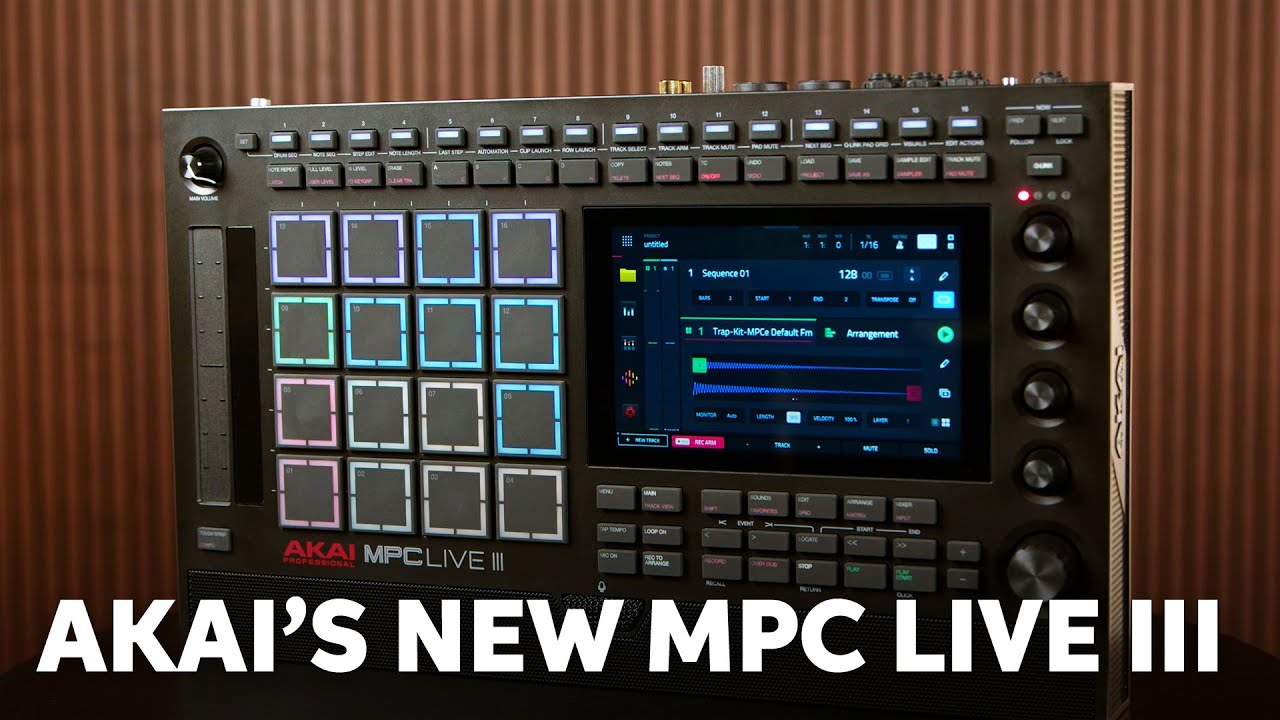
Here’s a full tour on the new Live 3. Some serious new features here and good usage of the touch strip and step sequencer. Plugin instrument limit raised from 8 to 32 per project. Faster memory (SSD) access confirmed, too. MPE pads look fun to use, and the individual zones can lit up individually - so much for the ‘waaah the pads look so ugly’ hate on reddit.
A missed opportunity, given the reduced battery life, is PD-support for that USB-C port, which would have been also interesting for other smaller units, like the Go or Mixstream (→powerbanks). But overall it’s a very promising upgrade, especially compared to all the incremental Plus or SE models.
Those pads on DJ gear would be wild.
Edit: i wonder if people still think that processor isnt powerful enough.
Aye, considering that overall innovation in the DJ business (aside from the Stems hype) was pretty stagnant over the past years, multi-zone pads would be a fascinating approach. Different sub-modes for either 32 instead of 8 Hot Cues, or 8 Hot Cues but with different key-shift variation, hold/release EFX, loop/stutter, etc. Or the Sampler finally put on steroids. Heck, maybe even SoundSwitch related fun when switching to the Engine Lighting GUI, or a multi-zone function split (assisted by small OLEDs like on the Performer).
Given the boost in parallel processing on the Akai unit, we should see overall stability and GUI responsiveness benefits, too. I guess track analysis itself won’t be 4x faster (as that’s a simple-core task, though even ‘just’ 2x speed would be sweet), but batch processing e.g. of a spontaneous playlist could become a new option. If DRM rules wouldn’t be as strict, the increased RAM and internal storage would potentially even allow to pre-buffer and analyze multiple streaming tracks at once ahead (rather than working sequential).
Quite exciting times ahead, certainly.
Those 8 cores in the chip seem to match the original M1 setup too, with the 4 performance and 4 efficiency cores. I guess that plays a huge part in being able to have multiple channels on the go.
Some of the stuff he is doing in this video is absolutely insane.
Akai are slowly morphing it into a Force/Push, with the 64 pad zones and the clips. The usual complaints in comments online though - it’s too expensive, it’s not an MPC any more, it’s the wrong colour, too many buttons….
Even people asking if the functions will be added to their old MPCs 
It blows my mind that people are saying the colour of the unit is a ‘dealbreaker’…. or should i say it translates to “im not a serious person, i was never going to buy this in the first place, in fact i dont even produce music, i just like looking at things”
Hehe yes, so many comments like that! You go to their channel and they’ve either got no content whatsoever, or a handful of random videos from 15 years ago, and 3 subscribers.
I found a great one yesterday. A YouTube channel dedicated to toilets. Thousands of videos, an average of 30 seconds long, of a guy flushing toilets in various locations. What the…?!
Hahahaha we must have seen the same people making the same comments.
- Weird Anime picture… check
- Videos that would be red flags if seen by a social worker… check
- Poor spelling and grammar… check
- Inane commentary on pretty much every subject… check
I look forward to the drill battery mods for power 
And subsequent fire safety announcements.
James Hype just had an aneurysm
If (a big IF, and hoping it does) this comes to the next generation of Denon/Rane players, it will move DJ’s into the live performance realm even further. And I’m here for it.
Edit: the synth on the iPhone connected to it via USB and the MPC Live 3 controlling it and the audio being routed in the unit  If team Denon utilizes this on the next gen then I hope they hook up an iPad with the RMX1000 App into the new player as a demo
Edit 2: the more I rewatch the MPC Live 3 walk through the more I can see the elements that can be used in the next Denon gen. I foresee a big FU to AT/Pioneer and Reloop Mixtour
Mentioning the comparison between Mac and current controllers, it takes my prime Go+ an insanely long time to boot up and it has no standby mode.
My Macbook air however boots in from cold in seconds and be left for weeks with little or no standby drain.
This isn’t a fair comparison .
Picture the MPCe pad 3D-sensing ultra-responsive pads designed for expressive performance On a new prime 4 + and new sc deck that will be mind blowing
Considering the matter, the addition of a new feature on the Prime 4+ with the touch FX pad on the screen, offering a 3D touch pad screen effect, seems like a potentially interesting concept, doesn’t it?
Doesn’t that already exist?
Ive just timed the Prime 2 boot up sequence, it took a total of 48 seconds before i had a track loaded to the deck and playing. It was 26 seconds to see the source select screen, a further 9 seconds to see the library, and then 12 seconds beyond that to tap a playlist, wait for it to update, tap a track then press load and have it playing.
My M1 Macbook Pro with 16gb RAM and 8 core upgrade, took 56 seconds to have a track playing in Apple Music, 47 seconds to see the desktop after firing it up. Waking it from sleep mode is much much faster, but then that isnt really a fair comparison.
Which one ,that is already exist?