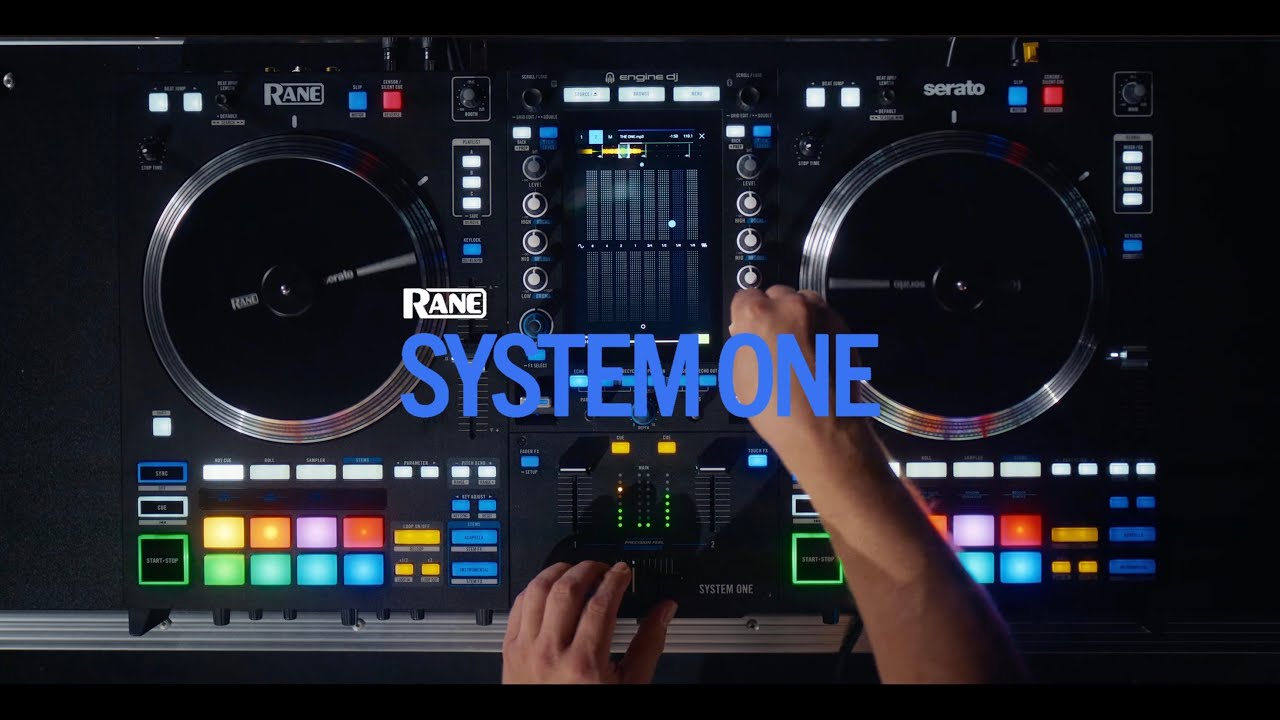
1:49. Stems onboard analysis comming soon
1:49. Stems onboard analysis comming soon
yup in the future update
Might not be what you think though. Stems analysis exists in Engine desktop software - but it’s not on the fly, and requires pre-preparing the files. Ditto with Traktor.
I suspect that it may well analyse, but it won’t allow you to load a new track, hit one of the stem buttons and get separation as you play.
(Hat on standby ready to be eaten) 
There will be some caveat, there always is. And with the current stems quality they’re not really worth using anyway.
The fact however that they have released a controller with dedicated stems controls and stems FX shows they are serious about it, or that could just be for Serato / VDJ etc …..
Only time will tell but I don’t think I’ll be buying one right now. Too much uncertainty.
No need for a separate thread. This was already discussed several times and confirmed to come around spring 2026. Until then (and beyond), I would recommend to pre batch-analyze on your desktop anyway. Much faster and more convenient. On-device rendering is just a bonus.
Vote 4 close.
This was announced before in a similar way… and today??
Nothing… what was advertised has quietly been changed to a free STEM license for prerendering.
In my opinion, anything under 10x speed is unusable in live operation anyway…
This machine promises real-time stems and comes with additional buttons with FXs in the stems, just like Serato. This will be possible on this device because its processor is four times more powerful than the Prime 4+
Promised by who?
It “promises” onboard stems analysis. That’s not the same thing.
The CPU may be improved, but it’s not 8 core like the new MPCs, and they’re still nowhere near real time.
It only says “Onboard”…
But onboard rendering would be really great… I want that too… 
I completely agree with @PKtheDJ here.
The wording used in the video, “stems rendering,” clearly implies that it will be a pre-rendering mode on the unit, possibly in the background. If it were “real-time on-deck load,” they would certainly have written something like “on-the-fly stems rendering” or “on-load stems real-time rendering.”
The devil is often in the details.
But the pre-rendering purists, “because storage is cheap these days” and “because it’s recommended to prepare your stems in advance anyway,” will probably find it to their liking.
In all fairness my DJ laptop is a 2019 Lenovo and can’t process realtime stems, so in VDJ I pre-render them on my home gaming machine and sync across and have never had any issues. I’d be happy enough if they were done that way on the System one but also decent quality.
You can be glad it was delivered this way, as if it were a consolation prize.
But if this platform is intended to remain in place for the next 5 to 7 years, then it’s still a tremendous missed opportunity, especially since chips capable of doing the same thing for only about $100 more already exist.
By the end of this platform’s lifecycle, AlphaTheta will have plenty of time, within a year or two, to release a chip capable of true real-time rendering and boast, “Look guys, we’re the first to have a chip capable of rendering stems live without pre-rendering in our standalone systems, while the competition is stuck with their 2020-to-2030 chip that can only do onboard pre-rendering.”
It was such a great opportunity to steal their thunder, what a shame!
I get your reasoning, on other parts of the forum as well, but most Pioneer users just stick to ehm Pioneer.
Realtime stems will not make them turn imho. Hell, even Laidback Luke seems to be using Pioneer again, while he went to DJAY, if I’m not mistaken. I still see his Reloop in the booth, but can’t confirm if what I say is true.
An SC5000 can still hold its own to the 3000X. Kinda 
Yeah, and a great opportunity to work with NI to follow the “open standard”, which would prevent vendor lock-in, pressuring AlphaTheta to do the same.
If I could be developing STEM tooling that would work in NI and Denon, I would, and people would put pressure on AlphaTheta to ensure that when they come out with STEMs, they are compatible with the STEM ecosystem and toolings provided.
And they don’t use stems either. I know a few guys who use CDJ3000 setups and they look at me like a mad person when I mention stems and how creative they can be when used correctly. They just use FX for their transitions, same as they’ve been doing for the past 20 years. One guy still has a massive folder of acapellas he plays on a 3rd deck 
The NI stems format is a thing of the past; record labels never really embraced it, except for a few niche labels in the underground electro/techno scene. No major label has ever adopted, and never will.
This is paradoxical, considering that stems are primarily used by open-format DJs to create mashups or remixes of mainstream tracks.
In short, the future lies in “real-time, on-the-fly stems stored in RAM upon loading,” like those used by DJay pro or VDJ.
And for that, you need a powerful chip and a bit more than only 4GB of RAM. 
Yes, on the previous generation, but it was definitely the opportunity to drive the final nail into the coffin and bury AlphaTheta for good, making them go from obsolete to completely outdated.
Since we know that InMusic’s chosen platform is intended to remain in place for at least five years, this chip choice is a fantastic opportunity for AT to catch up and make a smart move to completely turn the tables in their favor.
And all the head start InMusic has gained in recent years will have been completely wasted.
It is well known that DJs who are fans of Pioneer have rarely been at the forefront
I disagree. The format itself is not. It’s open for anyone to use, which is a great idea.
The reason it didn’t take off when released was - stem separation did not exist in DJ software, so the only content had to be released by artists/labels, and of course they were not open to the idea of people having access to the component parts of their copyrighted material.
Now, when we have stem separation being incorporated all over the place, the NI open format idea would benefit many, but each platform uses its own method. Denon even go as far as to encrypt the files.