Is this this a solution or an incomplete idea?

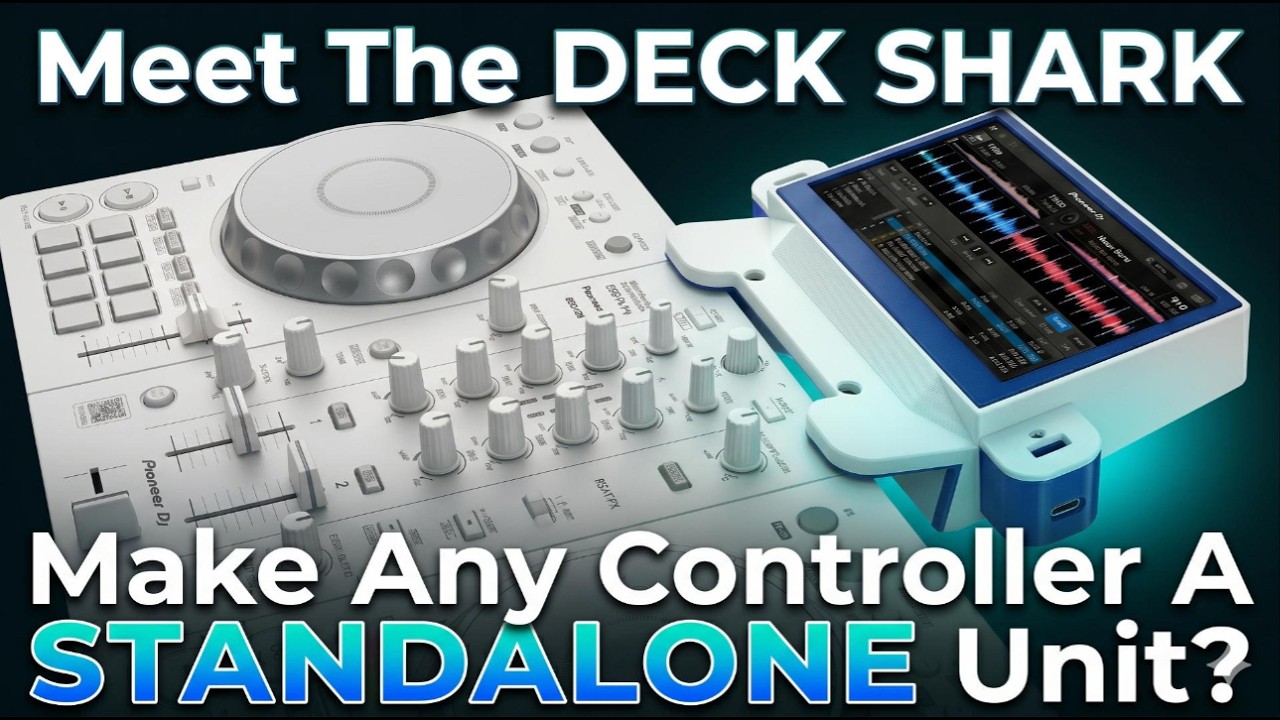
I stumbled across this video where in gist a DJ has made an attachable device that can turn a controller into a standalone device, my initial thoughts were this is a pretty cool idea but in reality it may not reach a wide enough audience what do you think and is this something InMusic should take note of?

Nice find. In line with the reloop strategy (using mobile phones). In another thread you’ll find discussion on processing power and how commodity hardware is more scalable. Using a fixed platform as InMusic is doing currently should have the merits of predictability and leading to a very stable solution.

I could see an engineos version of this

That’s indeed basic a tablet with a 3D printed casing/attachment :wink:

it could be feasable, but in the the end it hits the same limits as any DJ app, be it desktop or iPad/phone: you’ll need mapping for a myriad of devices, and a few cables more… with on the upside your library being portable “cross-device”…

All in all I think it’s a step back in DJ history where people where making or adapting their own controllers and midi mappings… This video would be on djtechtools in 2010 :wink:

I think you’ll find it’s a Raspberry Pi with a cheap screen ($40) running Mixxx on Linux.

As usual, anything but buying a Denon :joy: j/k

Interesting discussion.

While this approach requires additional hardware, it touches on a similar idea of expanding the user interface and available screen space.

I recently submitted a feature request for a wired USB-C/USB 3 tablet integration with Engine OS, where a tablet could act as a secondary performance display for waveforms, deck information, BPM, key, and library access.

For anyone interested, here’s the request:

https://community.enginedj.com/t/tablet-companion-mode-secondary-display-library-access/69669?u=dj_moonshiner

I think a tablet-based solution could provide some of the same benefits without requiring additional dedicated hardware.

[sarcasm]I had such a solution running. It was a laptop with Traktor 3, using CDJs in HID mode. I believe Rekordbox offers more or less the same functionality…[/sarcasm]

No, sorry for the sarcasm, but if you want a big screen with all the details, and a keyboard to search, nothing beats a laptop. If a laptop is too complex, you choose an all in one. A tablet is some in-between option, where I am not sure about the added value…

Engine misses a feature in this regard though: Engine OS can load tracks from a laptop, but the laptop can’t dictate a player to load a track, as rekordbox does. Many on this forum say this isn’t necessary, because when you choose Denon, you choose an all in one. But it all runs down to flexibility: if I want to be compact, I use a USB stick, if I play a longer gig where I want a keyboard, I use my laptop… Rekordbox offers this flexibility…

Oh, and in all this, to me, it doesn’t really matter where the playback of media actually happens. To me Traktor is the same as Rekordbox connected via Ethernet to a CDJ. Ofcourse, the former lets you add controllers, so no, it isn’t really the same. But suppose Pioneer came with some function connecting controllers to a CDJ, I wouldn’t be blown away, because it exists on Traktor…

I understand your point, and I agree that a laptop provides the highest level of flexibility.

However, I think the market has evolved quite a bit over the last few years. Applications such as djay Pro have shown that modern tablets are capable of handling advanced DJ interfaces, multi-deck waveforms, library browsing, hardware integration, and even professional performance workflows.

What I’m suggesting is not intended to compete with a laptop. If someone prefers a laptop, that option already exists.

The idea is to enhance the standalone experience by allowing a tablet connected via USB-C/USB 3 to act as a dedicated secondary performance display. This would keep waveforms, BPM, key information, deck status, and library access visible on a larger screen while freeing up the main Engine OS display for Touch FX, SoundSwitch, and other performance functions.

For me, the value isn’t that a tablet replaces a laptop. The value is that it extends a standalone workflow while maintaining the simplicity, reliability, and portability that attract many users to Engine OS in the first place.

More flexibility and more workflow options are rarely a bad thing.

Fully agree here.

Couldn’t agree more. It’s a battle of platforms and in next months/years software development will become a (ai-supported) commodity. Full closed systems will not be able to keep up with (user) extendable platforms.

I think InMusic did good with the ‘PC mode’, but establishing a (subscription based?) tablet or PC -app makes sense as an hardware integrator. I.e still earn revenue if a hercules controller gets sold and EngineOS is the preferred software platform.

Thanks, that’s exactly how I see it.

I don’t think every user would want or need a tablet integration, but giving users additional workflow options can only strengthen the platform.

My idea is simply one example of how Engine OS could become more flexible while still preserving the standalone experience that many of us enjoy.

Yeah, but if you connect a tablet it isnt “standalone” is it? There is no difference in logistics (space in the booth, cabling, …) between using djpro and your media players in midi/hid mode, or using your tablet as a secondary display to your players… That kind of reduces the added value and thus the motivation of a manufacturer to implement it?

I do agree on that one though. Admittedly this isnt the worst idea we have read on this forum :wink:

That’s a fair point.

The way I look at it is similar to using an external monitor with a PC or Mac. Most people would still consider the computer to be the main device, even when an additional display is connected.

In this case, the Engine device would still handle playback, library management, streaming services, analysis, and all performance functions. The tablet would simply act as an extended display and interface.

To me, that’s different from connecting a laptop and switching to software-based DJing, because the Engine device remains the heart of the system and continues to do all the actual work.

Of course, it wouldn’t be for everyone, but for users who want additional screen space while staying within the Engine dj, it could provide another workflow option.

I find the concept interesting in principle.

Obviously, what we’re looking at here is something of a DIY hack. But I’ve always thought that a solution where the onboard computing hardware (processor, RAM, etc.) is housed in a removable external module would be the ideal scenario.

Imagine you own an SC Live 4, and a few years down the line, it stops receiving updates because it lacks the processing power for new, resource-heavy features (like real-time stem separation, etc.)… Well, you’re stuck. You have no choice but to replace the entire unit—perhaps solely due to obsolete processing power—even though the rest of the hardware (buttons, faders, jog wheels, audio circuitry, etc.) might still be working perfectly.

Now, imagine a controller with a slot designed to hold a tablet of your choice (iPad or Android) running the Engine OS app.

The day your tablet is no longer powerful enough to handle new features, you simply swap it out for a newer, more powerful model. There’s no need to replace the whole machine when everything else is still working fine.

You end up with a fully upgradeable product—something that simply isn’t possible with standard standalone units, which quickly become obsolete if you want to stay on the cutting edge of new features.

Of course, if you’re a DJ who doesn’t care about the latest features and just uses your gear for basic, classic beatmatching, a standalone unit will suit you fine—provided it works and does what it’s supposed to do.

But if you opt for a controller with a docked tablet running Engine OS, you’re not really that far off from a standalone unit in terms of convenience. As a reminder, contrary to what its name suggests, Engine OS is not a true operating system but simply a standalone application running on top of a Linux kernel. Android is also based on a Linux kernel, while iOS is based on Unix—which is, for all intents and purposes, very similar to Linux.

In my view, it would therefore be entirely feasible to port Engine OS to Android or Apple tablets. Naturally, this would require some code modifications to support a wider range of chips beyond just Rockchip processors, but it is certainly achievable, given that most tablet chips—like Rockchip ones—are based on the ARM architecture.
Agreed, would require additional abstraction layer to support android/iphone, however in https://youtube.com/shorts/rvY73R7HZxQ?is=a778BbpobAb6WVBp (appreciate the video btw), it seems development happens in C language. Seems not impossible.

Interesting points from both of you.

I can definitely see the appeal of a more modular approach where processing power could be upgraded independently of the hardware. With how quickly technology evolves, especially around features like real-time stems and AI-assisted tools, it is an interesting long-term concept.

That said, my idea is actually a bit simpler and perhaps easier to implement.

Rather than running Engine OS directly on a tablet, I was thinking more about using a tablet as an extension of the existing Engine OS interface. The Engine device would still handle playback, analysis, streaming, and all performance-critical functions, while a tablet connected via USB-C could provide additional screen space for waveforms, deck information, BPM, key data, and library access.

One reason I find this interesting is that we’ve already seen projects like Deck Shark, where people are building Raspberry Pi-based solutions to add screens and standalone-like functionality to controllers. To me, that suggests there is genuine demand for expanded display options and alternative workflows.

Engine hardware already has powerful built-in screens and a dedicated operating system, so a wired tablet integration could potentially offer some of those benefits without requiring additional custom hardware or moving away from the standalone philosophy.

Whether it’s a fully modular future or simply a secondary tablet display, I think the common theme here is flexibility and giving DJs more workflow choices.

To me it suggest that a few people with controllers would like a standalone system on the cheap. :thinking:

I’ve not seen any evidence of people who already have a standalone with a screen, wanting to add another screen because they think it’s not big enough.

Logically if you want a large screen, buy a device with a large screen. If that means using a computer, so be it. Why buy an AIO with a small screen if you don’t think it’s big enough?

Regarding processor/RAM upgrades, see Ableton’s Push 3. It’s been designed to allow upgrades. One of the first things I did was replace the OS drive with a bigger one.

If the DJ systems were designed with a hatch for the SBC (single board computer) then it could be upgraded as required.

That’s a fair observation, and I agree that projects like Deck Shark are primarily driven by people wanting standalone functionality on controllers that don’t already have it.

My point wasn’t really that standalone users are unhappy with the size of their existing screens. What interests me is workflow efficiency.

For example, on Engine OS devices, there are situations where the main display is being used for Touch FX, SoundSwitch controls, settings, crate management, or other functions. In those moments, you temporarily lose access to performance information that was previously on screen.

I think you’re also underestimating how much workflow matters. Extra screen space isn’t always about replacing a small screen; it’s about improving usability. DJs have embraced larger and multiple displays for years because it makes browsing, preparation, and performance more efficient.

The same argument could be made against dual monitors on a computer, yet they’re extremely popular among professionals. More workspace doesn’t necessarily solve a problem—it can simply improve the experience.

A secondary tablet display could allow waveforms, deck information, BPM, key data, and library access to remain visible while the built-in display is being used for other tasks. So for me, it is less about wanting a bigger screen and more about having dedicated screen space for different parts of the workflow.

As for upgradeability, I agree that storage, RAM, and processing power are important. However, hardware upgrades and expanded display options can coexist and benefit different users in different ways.

Of course, not every DJ would find value in that, but I can see it being useful for those who prefer to stay within the standalone ecosystem while expanding what they can see at a glance.

Engine runs on ARM processors I think, so…should me doable.

It sounds to me as if you just don’t like the GUI design. With Touch FX for example, it’s your decision to open that screen. You know it takes over, so if you need to see something else, don’t open Touch FX - use the FX knobs and buttons. Ditto with SoundSwitch etc. Any screen, no matter how large, is going to have a finite amount of space.

BTW you don’t need to keep repeating why you want a second screen. I think you’re up to seven times now! :man_facepalming:

100% agree with this. It is rather common. I use a pi4 with 7inch touchscreen for a quick dvs solution at home also using Mixxx. Works quite well too. The issue with doing this (imho), it seems like an easy way to make money. But once you take the price of a pi4 / pi5, add a touchscreen, the power supply, the enclosure, the usb extension / hub etc… it all adds up rather quickly. Suddenly the simply cost is no longer as cheap as it initially seemed. Then the software & custom mappings for all the different controllers and then… who looks after the customers when they have problems? Nice for a diy project, but I dont know if I would be trusting this at a paid gig.