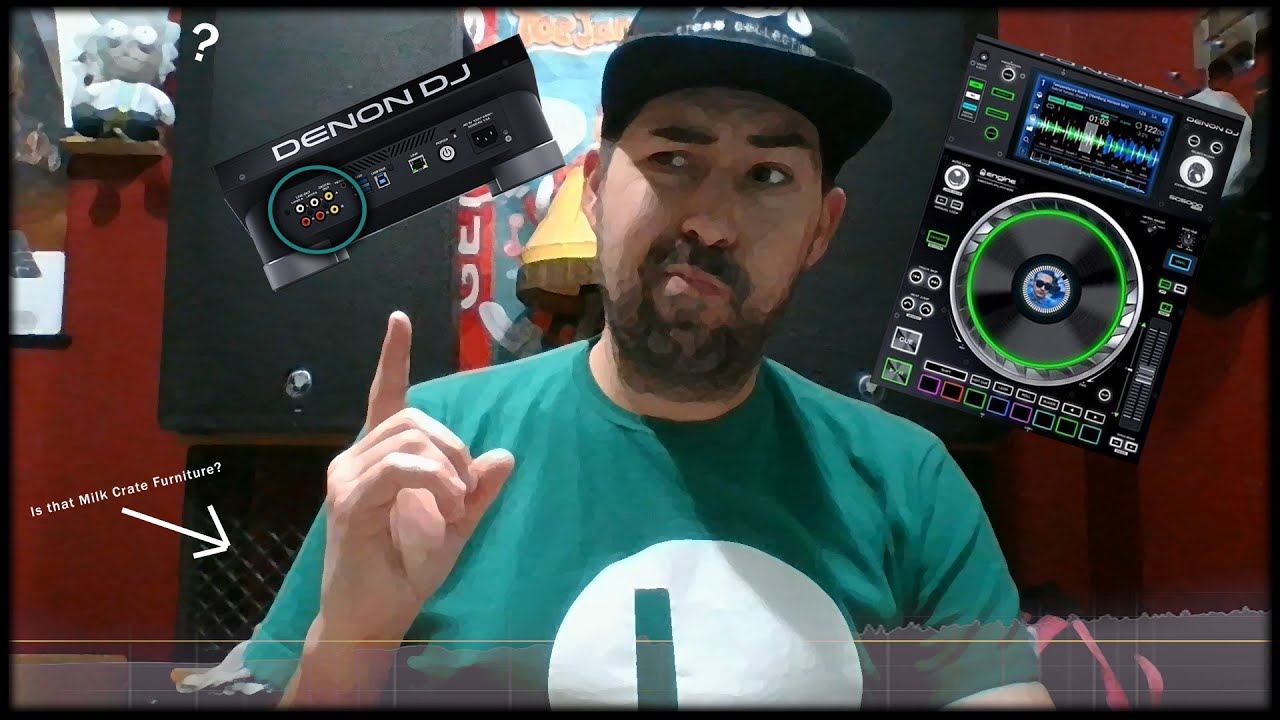
I do livestreams on YouTube. One of my viewers pointed out he thought the treble sounded a bit muffled. Of course I first assumed it was because of YouTubes audio compression, but when I sent him the raw MP3 recording, he said the same thing.
So this made me do a bit of an analysis and I can’t get my head around it what’s going on.
My setup is as follows:
Denon DJ SC6000 (Firmware 4.3.4)
Allen&Heath Xone:PX5 mixer
The SC6000 is connected via a short RCA cable (the one that was provided in the box)
The Allen&Heath mixer is connected digitally via USB to my PC, using it as an audio interface.
The interface is set to 24-bit 48000 Hz.
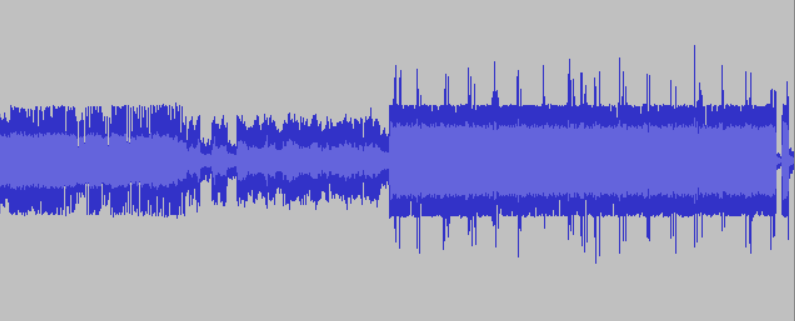
This is the waveform of the original 320 kbps MP3, loaded in Audacity
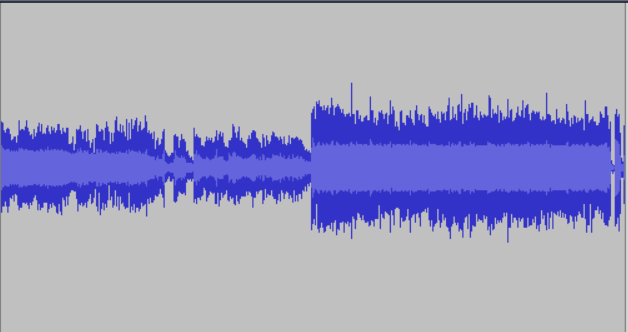
The recording is a tad less loud, this could be due to the gain knob needing a small nudge. But besides loudness, the waveform looks totally different…
Why is this?
I tried disabling the pitch sync, so that it doesn’t apply it’s time stretching algorithm. I saw LITTLE improvement but still…
Honestly, I do not hear the audio difference myself, but I’m 40+ so my ears might be ruined. The guy pointing this out to me is 25 years old.
I don’t have other knobs to play with so I’m just trying to understand this difference. I can’t rule out the Allen&Heath mixer because the SC6000 can’t record to USB. And I do not have a digital mixer so I can’t try the digital outs either…
I get it, there is a digital → analog → digital conversion going on, but is it really within expectations to see such a different waveform?
What I can see here is mainly a difference in dynamics/level, not a loss of high frequencies.
The upper waveform looks heavily limited/compressed, with large portions sitting very close to 0 dBFS, while the lower one clearly retains more visible dynamics. But a waveform alone cannot tell us whether high frequencies are missing.
If the tracks were normalized to 0 dBFS, that would not remove high frequencies simply because their energy is lower than the bass/midrange. If anything, excessive limiting could make the bass/midrange sound more congested or “mushy”.
So without the original samples, I wouldn’t draw any conclusion about the sound quality from these waveforms. A spectrum analysis of the exact same audio material would be much more meaningful.
These waveforms can tell us all sorts of things, but absolutely nothing that points to an influence of the player itself. To me, it looks much more like the result of rather aggressive gain/leveling, possibly combined with limiting or compression.
Playing compressed audio > mixer > encoder service streaming compressed audio > end user listening to YT compressed audio.
That person will never get true fidelity, IMHO who cares you’re not at 192k and frankly it could be their side not yours.
I stream on Twitch at 1080p, analogue from my SC5000 > XONE96 via USB> OBS 320k w/multiband comp, I’ve never had anyone complain audio the quality of my audio, in fact the opposite. I’d check the audio encoder settings on your side.
This original mp3 looks like it is squeezed out of its dynamic range. It is a good representation on how music should not be mixed…
Try to make these tests on better tracks with higher dynamic range and a wave or flac file. Then we could have a starting point to your issue actually…
You have two DACs in your chain with different specs. Then the audio is running through a gain stage, eq stage, volume stage, and summing stage before hitting the input on the interface. Xone’s also color the sound slightly.
When testing the sc5000, there was a slight rolloff above 16K, but nothing to write home about. I haven’t done a pink noise test for the sc6000’s.
Oh this triggers me! So you added a multiband compressor on the audio track that Twitch listens to?
Secondly, you say “320”, but that would be 320 AAC right? Because I have OBS on 160 AAC, which, according to Google, is roughly the same as 320 MP3.
I think I made conclusions that “something is wrong” based on the different waveforms. Both waveforms are already excluding YouTube or OBS as a cause, because it’s the original MP3 versus a lossless Audacity recording via the XONE audio interface.
Thanks for replying. I guess I made conclusions that “something is wrong” based on the different waveforms that I see visually. When I do spectrum analysis I can confirm it’s roughly the same.
Fair enough, but frankly reading all of your messages I don’t think there is a problem to solved. The fact that the audio is getting processing by such amount of steps, makes sense the waveform looks different.
I understand that, but the viewer who mentioned a difference compared the original mp3 with my local recording. And the original mp3 was considered “good”
Seriously the second (“faulty”) waveform looks much more natural. We can’t see/hear the high end difference from a waveform though.
I’ve not had quality complaints from Twitch listeners either, I play anything from vinyl to streamed tracks to WAVs, including 128k rips I made decades ago.
If the 128kbps MP3 is done properly with the right dynamic range and coded correctly, it can sound decent - not as good as 320’s or Waves, but still can sound good enough, that trained ear will not pinpoint it as an issue track.
However, it is always best to use the highes quality music we can get.
This is it. If it sounds bad, I change it. If it sounds OK, I live with it.
The older the track, the more likely it’ll have a restricted frequency range anyway, and be mastered for the consumer playback equipment of the time (etc). Some old stuff is in mono. Do I really need a lossless 24 bit 192kHz version? IMO no I don’t.
One thing to think about is that when that audience member was listen to your stream, they were likely listening to a re-encoded stream that could have reduced the sound quality significantly.
In no way shape or form could that be compared with someone listening to a live & local decoding of an MP3.
Yea a ReaXcomp VST for like 7 years, on the mic and the audio. Are you not using at the very least the built-in OBS comp & limiter for the mic and DJ audio? You’re broadcasting, you know just like radio, so treat it that way. Here’s a setup guide for a two instance audio recording, a stream feed and one without mic.
 The guy pointing this out to me is 25 years old.