It is common knowledge that the sound of Serato is quite colorful with a bump in the low frequencies, a peak around 1khz and a reinforcement in the high frequencies bringing a certain brilliance. It is a bias of Serato to have chosen to color the sound at the software output while most other software or hardware on the market is simply content to output a neutral sound faithful to the original recording
Have you by any chance just been reading the recent thread on the VDJ forum?
The guy who insists that using an EQ plugin on the output is improving the sound quality…

I haven’t seen this thread on the VDJ forum.
But I know that many Serato users are too used to the coloration of the Serato sound, and then when they switch to other equipment, whether CDJs/XDJs or standalone Denon equipment, the sound seems worse or “flatter.”
The human ear quickly gets used to using a colored sound, and then listening to the neutral, faithful sound seems more bland.
Actually I think all of the senses are state machines, where they only detect changes. When color grading film, I have to reset to a neutral image. When buying perfumes, I need coffee beans to reset my smell.
I’m not sure where you got this info from, but it is incorrect. I just checked this and RMAA shows that the frequency response is very linear (+0.23dB, -0.17dB from 40Hz to 15kHz). There is no bump in the low end, nor the mids or highs. It does have a steep roll-off near Nyquist, possible to avoid aliasing, but other than that the graph is pretty flat.
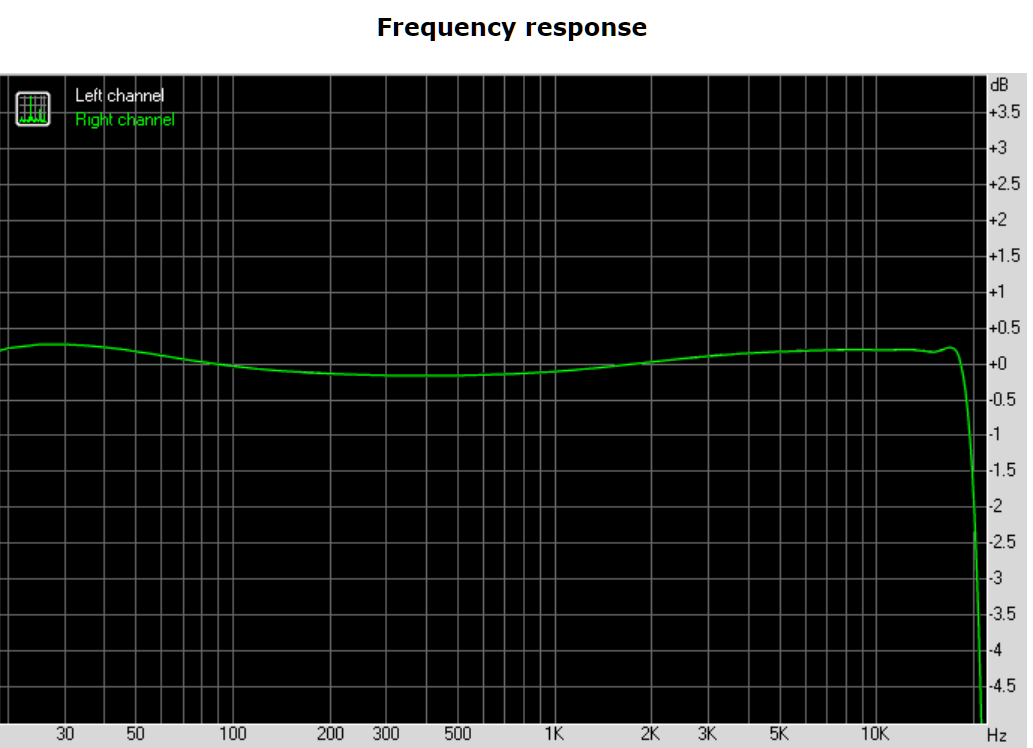
I recorded this internally in Serato itself. It makes sense too; such software should reproduce audio as transparent as possible, which turns out to be the case with Serato.
Here’s all the measured data, should you be interested: Serato.rar (40.0 KB)
I didn’t say it was a harsh coloration either; it’s subtle, but it’s there.
Certainly, there’s a slight bump of +0.23 dB in the bass, but you can see that from 100 Hz to almost 1 kHz, the lower-midrange frequencies are lower. And there’s a slight increase from 1 kHz (peak was an inappropriate term) that continues throughout the rest of the spectrum.
Certainly, a variation of +0.23 dB to -0.17 dB can be considered negligible, but on large sound systems, it can be enough to “feel” a difference for some people.
Do you have comparative measurements for the SC6000?
Hmm, I would say this variation can still be considered neutral enough. Not 100% perfectly flat, and measurable, but still subtle (as you notice, the range on the y axis goes in 0.5dB increments, so any subtle variation in amplitude is quite visible). Just a gentle eq tweak on a channel would probably do a lot more already. If anything, the alleged 1kHz peak is not visible.
I don’t have data from an SC6000, but I do from the Prime 4. Link to rar file in this post. Talking about frequency response, it says -1.58, +0.06 from 20 Hz to 20 kHz, and from 40 Hz to 15 kHz it is -0.84, +0.06. Basically the mid range is very flat but it rolls of both in the low and high end. RMAA calls that “Good”, most other aspects are considered Excellent.
Anyone (at least with a Windows system) can test this by the way, the software is available for free: RightMark Audio Analyzer. Products. Audio Rightmark
It provides valuable insights into various aspects of audio performance 
Not that I can tell. You could just play sparser, easier to process music. Analog mixers, tubes, and transformer distortion may help cover it up, or they might push the distortion past a noticeable threshold of detection for you. YMMV. Or you can just go nuts with the key change since it’s already pretty mucked up by default to begin with. Using hi res lossless files and no key lock, though, will allow the players to output the best sound they are able to currently produce without further improvement of the firmware audio processing, but that’s pretty constraining for the DJ, and even then they’re basically like playing an MP3 on most other brands. In for a penny, in for a pound, so I say if you’re living with Prime, then enjoy the features.