Improvents tips, new Hardware, players from Denon this year?

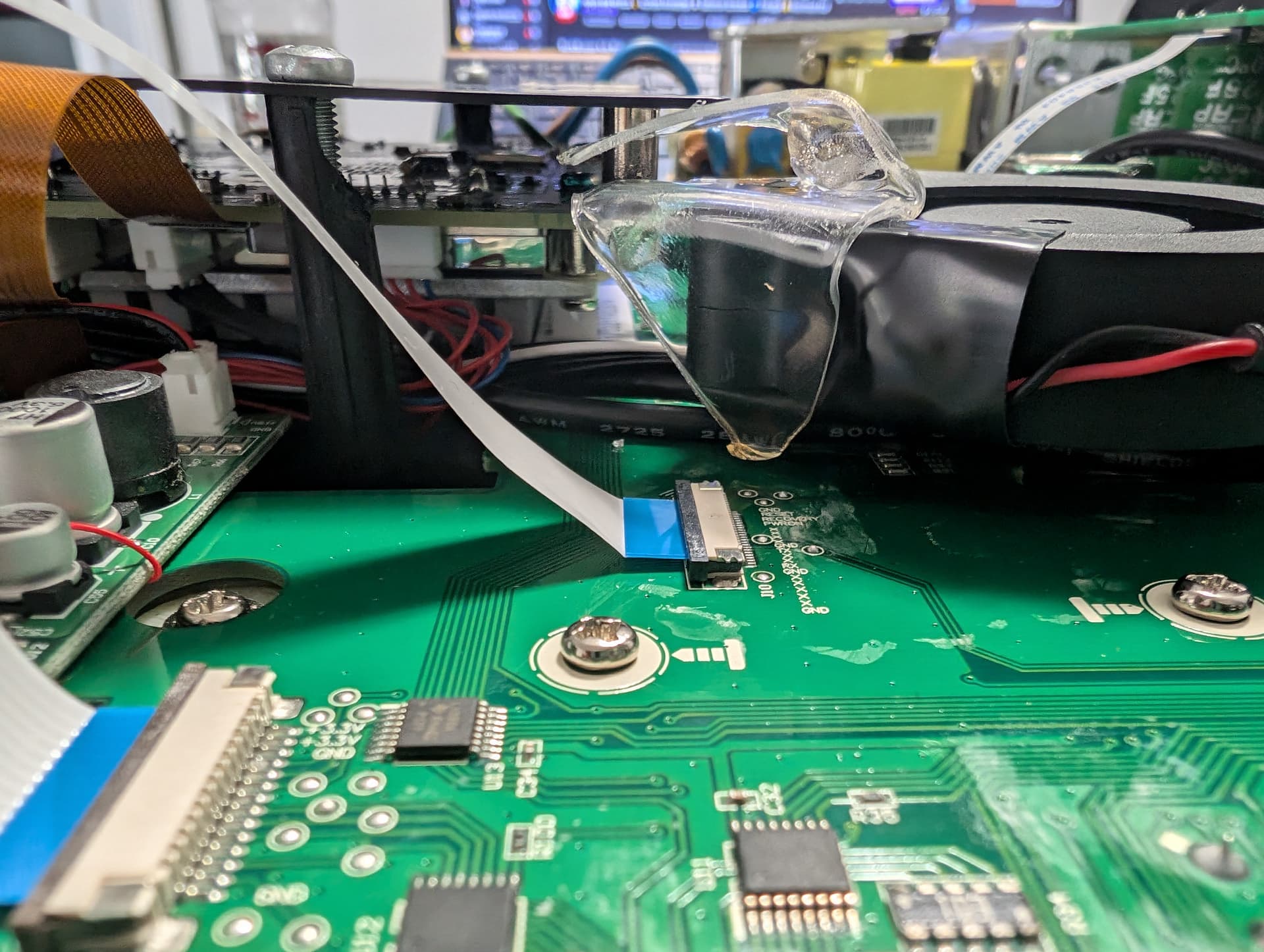
The best thing you can do is avoid squeezing the players completely together and leave a small gap between them. It’s essential that the air intake of the left side fan is not obstructed so that a flow of fresh air can always circulate through the drives and cool the components.

You could put a small heatsink on this component as indicated in @Ghiata_Loredan 's other post, but that would require you to disassemble each device.

1 Like

@Ghiata_Loredan has already done all the work.

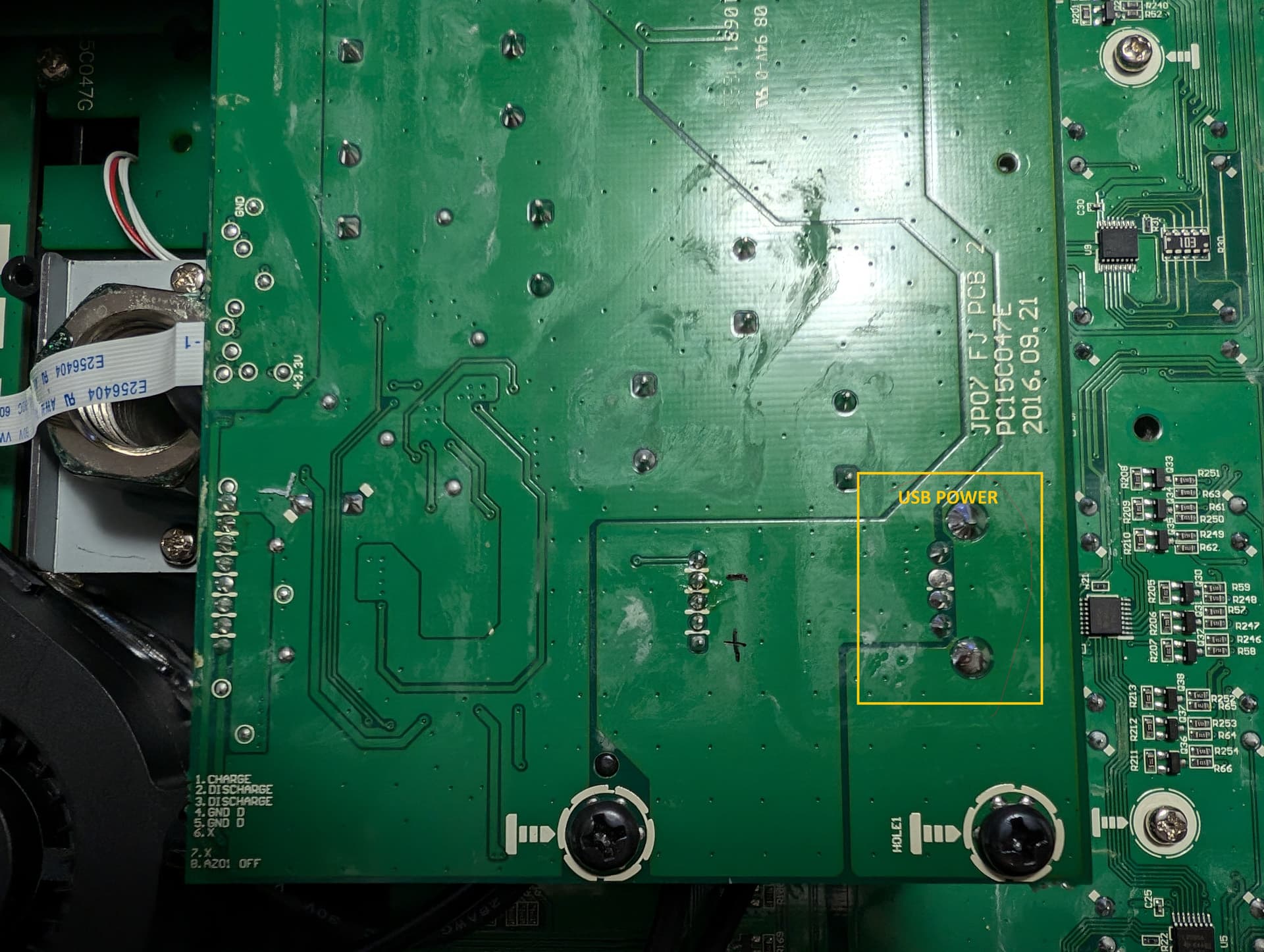
All the photos of the circuit and the components involved are in this thread (last post).

1 Like

You can. I modded my SC5000 with a mini USB fan internally to force air across the main processor and soldered the fan power to the front USB bus. Cooling the SC5000 eliminated any issues I was having with random drive disconnects and other drive indexing.

note: My device was out of warranty and I personally am willing to take risks, don’t try this at home kids.

6 Likes

Thanks. My decks are well out of warranty and I even considered developing some custom electronics to siphon off the MiPI DSI screen data for external publishing.

Ultimately I didn’t do it because I found an alternative that suits my needs for now

2 Likes

another post about this issue

1 Like

As happens on most posts, for most manufacturers, in amongst the real issues and suggestions, are a selection of one-off or really rare occurrences, passed off as “issues of mass destruction”

Sure, the faders can fail (even for the “my unit never leaves the house and I only ever touch my unit using devoutly religious peacock feathers, no more than about 1 hours usage per decade brigade) and yes, the disappearing “View” button was an issue on the early issue Prime 4 … but failing displays for example, no.

Sure there have been the occasional display failing either jog display, or the touch screen either detecting touch but not displaying, or displaying but not detecting touch, but not exactly common.

Such rare things are big in the minds of the handful of users it happened to, but not common enough, worldwide issues to be included fairly in a “things that need to be improved” thread. It would be like someone somewhere who’s managed to damage the front left upper corner of their unit posting that it’s a worldwide pandemic of failing front left upper corners and that it’s a worldwide design flaw etc etc

But yeah some of the original suggestions on this opening post are good areas for consideration.

In contrast, suggestions to all regarding drilling holes in Primes, is not a particularly wholesome course of action.

I truly admire your tenacity in trying to put things into perspective, and not to say wanting to defend the indefensible.

But when we’re faced with obvious design problems like the view button on the P4/P4+, the Cue/Play buttons with a plastic frame that’s too thin and fragile, or the lack of a heat sink worth a few cents on a fundamental component like a voltage converter, which, if burned, can turn your $1,700 unit into a paperweight, we have to admit it.

Do you know why Japanese cars, Lexus and Toyota in particular, are the most reliable cars in the world?

Because they apply the fundamental principles of Kaizen.

This is a philosophy of continuous improvement developed in Japan and based on the idea that the path to excellence can only be achieved through daily and unlimited “small” improvements.

Here are the 10 rules governing this philosophy:

  1. Abandon fixed ideas, reject the current state of affairs

The company therefore encourages all employees to actively seek improvements, question the status quo, and propose improvements, even and especially if they seem minor.

  1. Instead of saying what can’t be done, think about “how to do it.”

  2. Try and then validate

This approach requires testing and validating even the smallest idea before any implementation.

  1. Implement good improvement ideas immediately.

The speed of implementation and meticulous monitoring of an improvement idea are at least as important as the idea itself.

  1. Don’t strive for perfection, gain 60% now.

  2. Correct the error immediately.

Letting a defect linger without correcting it as quickly as possible is the best strategy for it to propagate through the production line and reach the customer.

  1. Difficulties and problems are sources of progress.

It’s by learning from mistakes that we grow.

  1. Look for the root cause, and then look for the solution.

  2. The ideas of 10 people are better than the potentially brilliant idea of ​​just one.

Imperfect humans remain incapable of identifying and considering all aspects of a problem. Teamwork can best circumvent this problem.

  1. Improvement is infinite, there are no limits.
4 Likes

:scream:Fantastic post @Gaian! :sparkling_heart:

1 Like

Thank you @djliquidice

The Kaizen philosophy is scrupulously applied by many Japanese companies in a wide range of sectors, such as research, hi-fi equipment, cutting-edge technologies, etc.

This is why major Japanese brands have long had, and still have, a reputation for solid and reliable products.

This is also why many believe that older Denon DJ products, when they still belonged to Denon Japan, before the InMusic era, were more reliable. Because they were made in Japan, not in China or Taiwan.

It is important to understand that in Japanese culture, companies place great importance on ensuring the end customer is completely satisfied. And any failure is experienced by any member of the company, from the lowest employee to the highest executive, as a profound disgrace.

Japanese companies choose long-term strategies such as capitalizing on brand image, reputation, and customer loyalty. While Western companies are primarily focused on short-term profitability.

If InMusic had continued to scrupulously adhere to the Kaizen principle, we would likely have not only the most advanced but also the most reliable DJ products in the world.

I’m not saying there can never be problems with Japanese products. But these are extremely limited, and the defective product rates are generally not comparable to those of Western manufacturers.

3 Likes

You put far too much weight on Kaizen, it’s not all it’s cracked up to be, and Japanese companies no longer have the reputation for reliability, it’s not the 1980s any more.

The thing about Toyota is also largely a massive fallacy, they have as many recalls as any other manufacturer, some for serious faults in their cars too.

Look at all the huge manufacturing issues plaguing camera companies, Japanese camera companies, so much for a lasting legacy.

3 Likes

@STU-C

There can of course be problems here and there, such as the “killer” airbag issue with Takata, which is a Japanese company and is used by other manufacturers around the world, including Japanese ones.

But overall, check out any reliability survey regarding recall and problem rates for global automakers, and you’ll see that Lexus and Toyota have held the top two spots for at least five or six years, followed by Honda and the Korean manufacturers.

Western manufacturers are far behind in reliability.

It’s splitting hairs though, it’s not like they are miles ahead in some league table, it’s all much a much when it comes to recalls and reliability with some a touch better than others.

Also, for the price they cost, I would hope a Lexus doesn’t break down, they are a fortune.

Those league tables are the equivalent of fanboys arguing because their chosen brand of car can do 0-60 in 0.1s faster than another. Great subject for arguments but also laughable in reality.

The exact same thing can be said about a Prime 4/4+ or an SC6000/M.

Of course, it’s not comparable to the price of a Lexus, but for supposedly high-end DJ equipment, we expect much stricter quality controls.

When you invest $2,500 in a Prime 4+, you don’t expect your view button to collapse internally when you press it, just as you don’t expect when you spend $1,700 on an SC6000M for it to suddenly stop starting one morning because the voltage converter powering the motorized platter overheated, even though this could have been avoided with a $1 heat sink.

This is acceptable for entry-level brands like Hercules, but not for brands like Denon DJ or Pioneer/AT, which are supposed to be the “Lexus” of DJ equipment.

1 Like

Denon DJ is nowhere near the level of Pioneer/Alphatheta regarding price or market dominance, for you to suggest they are is being purposefully obtuse.

You want a 4 channel standalone that’s over £1500 cheaper than the market leader, you get components that reflect the price, there is no free lunch.

You want a media player that’s £1000 cheaper than the market leader, you get components that reflect the price.

Anyway Gaian as always I know you will just keep commenting until you’ve absolutely had the last word. So I’ll dip out of this little conversation, as ever it’s been fun reading your ‘I’m right and every single person in the world is always wrong’ comments again, toodle pip.

Quality control on Denon gear has been an issue forever. MC6000 Mk2 had failing selector switches, MCX8000 had a bad IC on the displays and collapsing play/pause buttons, X1800 had problems with buzzing, X1850 had failing OLED displays. Tact switches have been a continual pain for probably 20 years now and having to completely dismantle a unit to remove a board to replace faders is just the worst thing ever.

Saying that I just read today someone received a brand new AZ and it’s borked on arrival.

If you look on Reddit, there are many reports of faulty AZ being delivered, by that Japanese company Pioneer DJ/AlphaTheta, must be the Kaizen.

1 Like

I agree with you in principle.

Even if I find the argument a bit fallacious in part, because we both know that Pioneer/AT are more expensive because they think they’re Apple and, above all, generate a higher margin on each product, and not because the components are of better quality. The proof is that the MPU used in the CDJ3000/AZ is far from the performance of our old “2014 Rockchip.”

I’m just saying that sometimes, for a few dollars more (not $1,500), a small heat sink or buttons made of more durable plastic can make all the difference for the end customer.

For that to happen, you have to have conducted the appropriate durability tests during design and have real control over the production chain.

Besides, Pioneer products are much less reliable today, now that they’re made in Taiwan, and Pioneer DJ belongs to AT and no longer belongs to Pioneer Japan (coincidence?).

I don’t remember there being such problems or other recurring problems on the x1700 which was of incomparable robustness

My x1700 is still going strong and built like a tank. My only issue is that Denon DJ decided to stop doing firmware upgrades for it when they released the X1800 (trying to force an “upgrade” on people) so the internal sound card would still work.

@SirReal The X1700 is one of the last true products in Denon Japan’s DJ line. Check yours, but I’m pretty sure it says “Made in Japan” on the label.

@Homeland101 The MC6000 MK2 and MCX8000 are products that were conceptualized under the Denon Japan brand but were put into production under the InMusic brand era after the acquisition of the Denon DJ division in 2014. And InMusic, like any Western company, does not share the same philosophy as the Japanese company from which it acquired the brand, preferring to focus on short-term profitability, economies of scale, and cost reduction.

1 Like