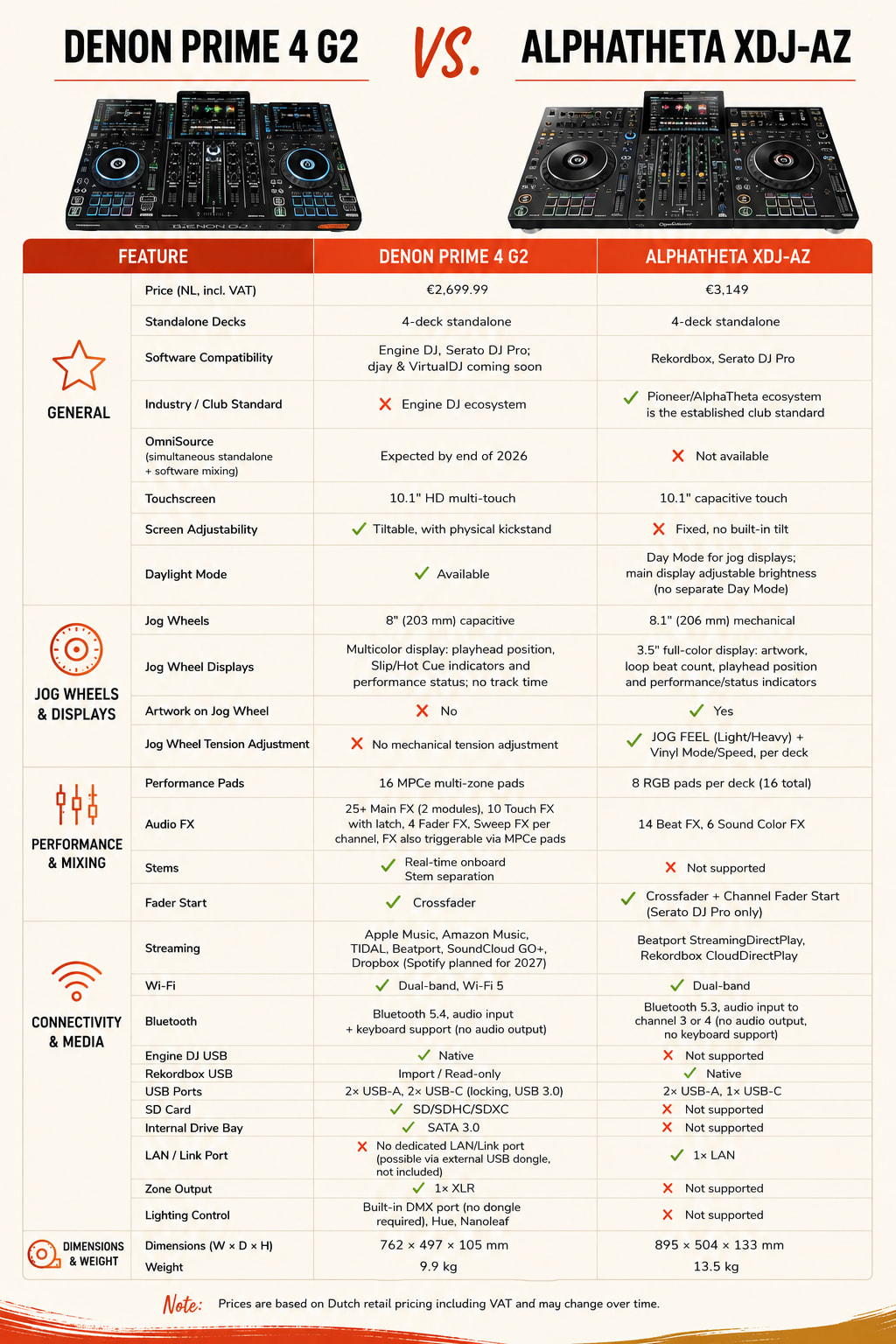
Feature Comparison: Denon Prime 4 G2 vs Prime 4+ vs AlphaTheta XDJ-AZ
A side-by-side comparison of the three standalone DJ systems, focusing on hardware, standalone functionality, media support and connectivity.
(based on XDJ-AZ vs Prime 4+)
General
Feature
Denon Prime 4 G2
Denon Prime 4+
AlphaTheta XDJ-AZ
Price (incl. VAT)
€2,699.99
€2,150
€3,149
Standalone Decks
4-deck standalone
4-deck standalone
4-deck standalone
Software Compatibility
Engine DJ, Serato DJ Pro; djay and VirtualDJ “coming soon”
Engine DJ, Serato DJ Pro, VirtualDJ
Rekordbox, Serato DJ Pro
Industry / Club Standard
Engine DJ ecosystem
Engine DJ ecosystem
Pioneer/AlphaTheta ecosystem is the established club standard
Nice comparison. But Pioneer/AlphaTheta have had “OmniSource” (simultaneous standalone + software mixing) for as long as they allowed HID-mode. So 2/3000, XZ, AZ they can all switch between USB & Laptop.
fader quality (confirmed dual-rail on the G2, standard on the other ones)
crossfader easily replaceable/upgradable on the P4 and G2, not on the AZ
Since you listed an extra point for artwork on jog screens (which I regard as gimmick btw) then other aspects like numeric values (AZ), or Hot Cue Countdown (G2) should also be listed… but its easier to summarize that the screens on the AZ are simply superior, while G2 vs P4 have different pros and cons
G2 and P4 have many more layout and customizing options (UI, deck colors, etc.)
Screen has a fixed angle on the AZ
AZ has 3-band EQ not 2-band for both Mics
Best Autoloop knobs on the G2, small ones on the P4, buttons on the AZ
AZ has better EFX assign/routing options, P4 and G2 have a two MainFX engines
AZ has hardware Quantize and Vinyl Speed Adjust On/Off buttons
G2 and P4 have superior pitch sliders + finer pitch increments (0.01%)
The power of having Crossfader start in standalone mode is an advantage.
I really hope the G2 gets Channel fader start as for me that’s the complete standalone upgrade path I’ve been waiting and hoping for!
Unfortunately, as pointed out you still need SERATO or DJAY to activate Channel fader start.
You really have to have both in your tool box. Otherwise, you’re stuck with using Crossfader start in standalone or your forced to use your laptop to gain the more useful Channel fader start.
I’m staying optimistic though, unless I’m informed the G2 isn’t capable of Channel fader start by design.
Very exiting, looks like an amazing unit. I took a while to get the message about the jog wheels. I love the construction on the Prime 4 series. As a stand alone unit Prime 4 is the best no doubt in my mind. I hope the same way that they have worked on the unit, they put the same effort to update Engine DJ. That is where I find the weakness.
Currently I use VDJ and Prime 4+ as a controller. and the difference in price compared to controllers at that level considering the hardware is worth in my opinion. I found Engine DJ very limited, mainly due to the workflows. But Prime 4 still the best units as a stand alone and also as controller for me. I am curious about the integration of VDJ in the new unit.
I would also like to add, that on Prime 4 G1 and G2, you can save 8 hot cues and 8 loops independently, where on Pioneer units, you have 8 hot memory slots shared between loops and hot cues. So 8 buttons, if you have 5 hot cues, you can save only 3 loops extra, and that’s it.
On Prime units, you are not as limited.
Yes, it’s totally redesigned from the start. Inside there is nothing left of the old Prime 4.
I do think the AT guys make smart decisions within the boundaries they have. I also don’t think this is really a technical problem. It’s more that they are somewhat trapped by their own established standard and workflow.
On the one hand, people complain about all the things they want to see changed, only to explain in the very next sentence why they need everything exactly the way AT has done it for years — because they are used to it and know the workflow inside out.
Put simply: AT knows very well that introducing something like the FX rocker on the G2 would probably cause a shitstorm of epic proportions.
And that’s where we get things like the super-duper DACs, soldered under moonlight and carefully sprinkled with the blood of virgin frogs, because apparently that’s what delivers the ultimate result.
If you look at it purely objectively, though, Denon has been winning the feature/functionality race for quite some time. The G2 wasn’t really needed to establish that.
AT simply has one item on its feature list called “industry standard”. But nobody ever said there can only be one standard.
And ultimately, the standard is being defined by those who want the capabilities of a G2 — just wrapped in an AT workflow and ecosystem.
I also hope inMusic decides to bring the current club series up to the level of the RS1 / G2. That would make things really interesting.
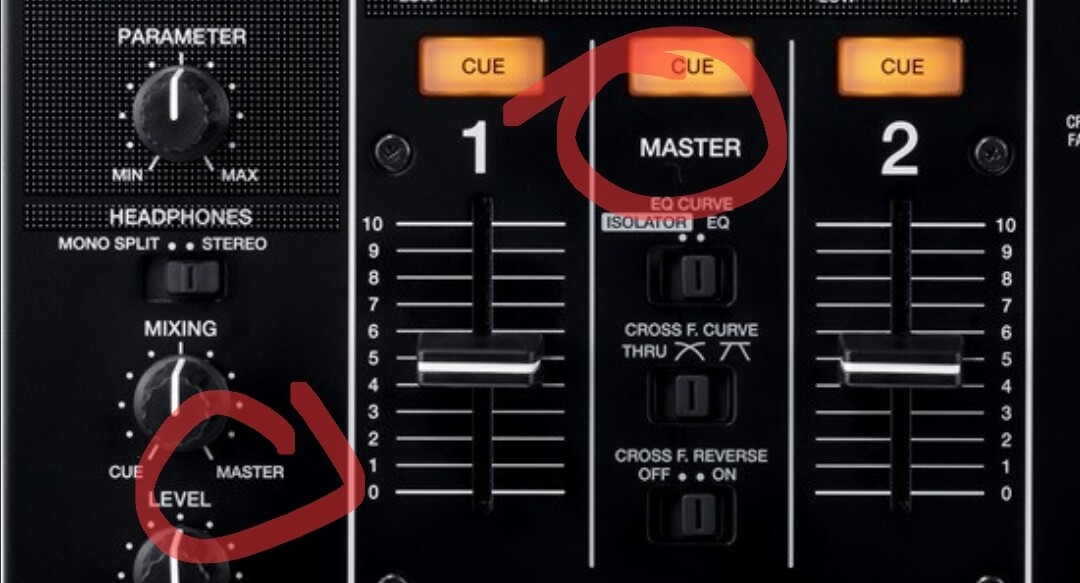
I’ve only met one DJ who ever actively toggled the master cue button on Pioneer DJ gear. I think they were also inebriated, and hitting a button with “master” glowing was easier than fumbling for a knob. Considering the lighting sometimes in venues, I might need to try that.
Which brand/model is the one in that photo? An all-in-one console or two channel mixer with split cue button/switch? Either is pretty rare.
Changing the DAC from AKM to ESS on a unit running Engine OS is like putting rambling rose red lipstick instead of blazing sangria red lipstick on a pig. They’re both red lipstick, and it’s still a pig.
I think arguing about which of the two brands “sounds better” is pretty much absurd. Most of what people claim to hear is probably imagined rather than something that plays a meaningful role on a PA system at typical DJ levels.
For me, the overall concept is what matters — and especially how linear the system remains right up to the clipping limit.
Believe me, the two major players are quite different in that respect.
Up to 0 dB, everything is fine. Neither is really better or worse in any meaningful audible way. If someone claims to hear a significant difference there, I would call that wishful thinking.
But once you push beyond 0 dB and start approaching the limits, things get rather interesting…
And honestly, I don’t think the comparison is entirely fair at the moment anyway. AlphaTheta didn’t really have much to counter even the original Prime 4 with. The main thing they have going for them today is their market penetration.
And that’s also what they are somewhat trapped by.
 4-deck standalone
 Engine DJ ecosystem